

TL;DR: Too long, Didn’t read
The Right: Under the Consumer Credit Act 1974, you have the legal right to end a PCP or HP finance agreement early.
The 50% Rule: You can walk away penalty-free if you have paid (or are willing to top up to) 50% of the Total Amount Payable.
The Trap: This is different from “Voluntary Surrender” (which ruins your credit). Make sure you use the words “Voluntary Termination.”
Condition: The car must be in “Reasonable Condition.” You don’t have to pay for normal wear and tear, but you will pay for big dents.
You bought a car on PCP or HP finance. It seemed affordable at the time. But now, bills have gone up, you’ve lost your job, or you simply don’t need the car anymore. You check your settlement figure, and it’s terrifying: You owe £15,000, but the car is only worth £12,000. You are in “Negative Equity.” You feel trapped. You aren’t. There is a legal escape hatch written into your contract called Voluntary Termination (VT).
What is Voluntary Termination?
Voluntary Termination is a right given to you by Section 99 of the Consumer Credit Act 1974. It allows you to hand the car back and wipe the remaining debt, provided you have paid 50% of the total cost. This protects you from being stuck with a car you can no longer afford.
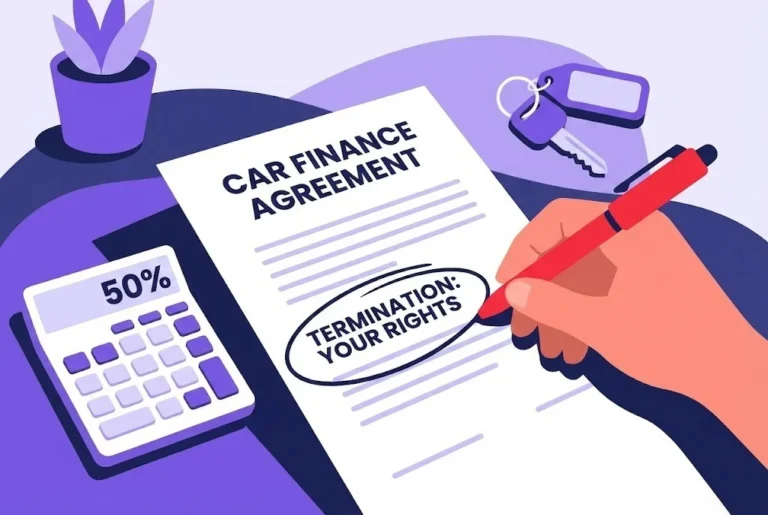
How the “50% Rule” Works
This is the most confusing part. The “50%” refers to the Total Amount Payable (including the deposit, monthly payments, interest, and the final Balloon Payment/GMFV). It does not just mean halfway through your time agreement.
The Calculation:
Look at your original contract. Find the “Total Amount Payable” figure (e.g., £30,000).
Calculate 50% of that (e.g., £15,000).
Add up what you have paid so far (Deposit + Monthly Payments).
The Result:
If you have paid MORE than £15,000: You can hand the car back today and pay nothing more.
If you have paid LESS than £15,000: You can still hand the car back, but you must pay a lump sum to reach the 50% mark.
VT vs. “Voluntary Surrender” (Don’t Be Tricked)
When you call the finance company, they might say: “Okay, we’ll collect the car and sell it at auction.” STOP. This sounds like “Voluntary Surrender.”
Voluntary Surrender: They sell the car at auction for a low price. You still owe the difference between the sale price and your debt. This leaves you in debt.
Voluntary Termination: You hand the car back. The debt is wiped. You walk away free.
Action: Always write a letter/email clearly stating: “I am exercising my right to Voluntary Terminate under Section 99 of the Consumer Credit Act.”
What About Damage and Scratches?
You must return the car in “Reasonable Condition.”
Acceptable: Small stone chips, worn tyre tread (above legal limit), light scuffs on seats.
Not Acceptable: Deep dents, cracked bumper, ripped upholstery, warning lights on the dashboard.
If the car is damaged, fix it before you hand it back. It will be cheaper to pay a local body shop £100 than to pay the finance company’s inflated recharge bill.
Step-by-Step Guide to VT
Check the numbers. (Have you hit the 50% mark?).
Take photos. Photograph every inch of the car (inside and out) with a date stamp. This is your proof of condition.
Send the letter. Do not do this over the phone. Send a formal email/letter invoking Section 99.
Arrange collection. They will come to pick it up. Do not sign anything that says “I agree to pay for damages” unless you actually agree.
A Quick Story: Meet Lisa
The Problem: Lisa had a Mercedes on PCP. She lost her job and couldn’t afford the £400 monthly payments.
The Debt: She owed £18,000, but the car was only worth £15,000. Selling it would leave her with a £3,000 debt.
The Solution: She checked her paperwork. The “Total Amount Payable” was £32,000. The 50% mark was £16,000. She had already paid £16,500.
The Win: She used Voluntary Termination. She handed the keys back. The finance company tried to charge her for “excess mileage,” but she refused (VT rules usually waive excess mileage). She walked away debt-free.
Summary: The Escape Hatch
Find your contract.
Calculate the 50% point.
Write “Section 99” in your email.
Frequently Asked Questions
Will this affect my credit rating?
It will show on your credit file as a “Voluntary Termination.” This is not a negative mark (unlike a default or CCJ). However, if you do it repeatedly (e.g., every year), some lenders might be reluctant to give you car finance again in the future.
What about Excess Mileage?
This is a grey area. Finance companies will try to charge you for going over the mileage limit. However, the law says “you must pay 50% of the total price.” It does not explicitly mention mileage. Many experts argue you do not have to pay excess mileage fees on VT, but be prepared to argue this.
Can I do this with a Personal Loan?
No. Voluntary Termination only applies to PCP (Personal Contract Purchase) and HP (Hire Purchase) agreements where the loan is secured against the car. If you bought the car with a standard bank loan, you own the car, and you cannot hand it back.
This guide applies to regulated Hire Purchase and PCP agreements in the UK. Leasing (PCH) contracts cannot be voluntarily terminated in this way.