

TL;DR: Too long, Didn’t read
The Golden Rule: A Debt Collector has ZERO special powers. They are just private citizens. They cannot enter your home or take your goods.
The Bailiff: A Bailiff (Enforcement Agent) has a court order. They can take goods to sell, but they still cannot force entry for most debts (like credit cards).
The Trick: Companies make their letters look like Bailiff notices to scare you.
The Action: Never let a Debt Collector into your house. Talk to them through the letterbox only.
You hear a knock at the door, or you open a letter with red bold text saying “NOTICE OF RECOVERY.” Your heart stops. You picture men in vans taking your TV and your car. Stop. 90% of the time, these people are Debt Collectors, not Bailiffs. Understanding the specific legal differences between Debt Collectors vs Bailiffs is the single most important financial lesson you will learn this year. One has the power to ruin your day; the other is just a call centre worker with a fancy letterhead.
In this guide, we break down the powers of Debt Collectors vs Bailiffs so you never have to be afraid of your own doorbell again.
Debt Collectors vs Bailiffs: The Main Differences
Many people use the terms interchangeably, but legally, Debt Collectors vs Bailiffs are completely different entities with vastly different powers.
1. What is a Debt Collector? (The Paper Tiger) A Debt Collector is simply a private company hired to chase a missed payment.
Examples: Lowell, Cabot, Pra Group.
Their Powers: None. They have the exact same legal power as your neighbour or a pizza delivery driver.
What They CAN Do: Write you letters, call you (within reason), and ask you to pay.
What They CANNOT Do: They cannot enter your home, take your goods, or threaten you with prison.
2. What is a Bailiff? (The Real Threat) A Bailiff (legally called an “Enforcement Agent”) acts on behalf of a court. They are usually collecting Council Tax arrears, parking fines, or CCJs.
Their Powers: They hold a “Warrant of Control.”
What They CAN Do: They can visit your home to take goods (TVs, consoles) to sell at auction.
Can They Break In? For Civil Debts (like credit cards), NO. They cannot kick down your door. They can only enter through an unlocked door.
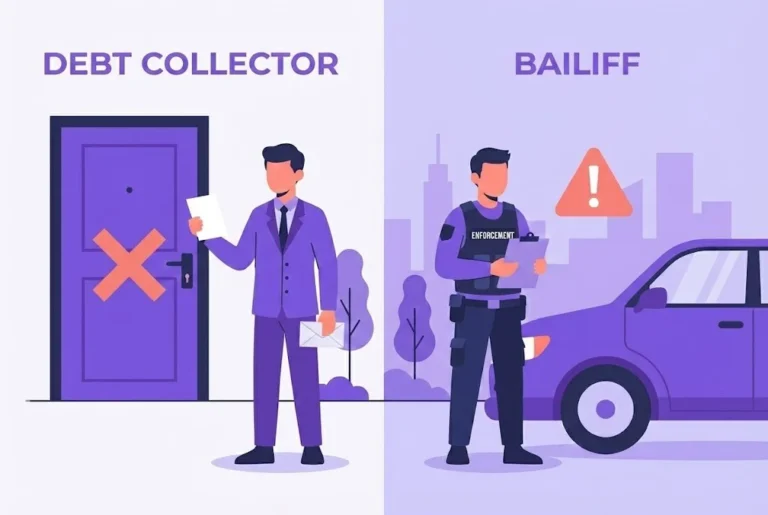
How to Spot the Difference
When comparing Debt Collectors vs Bailiffs, the main giveaway is the wording in their letters. Companies often make Debt Collector letters look like Bailiff notices to scare you.
Debt Collector Language: “Authorized to recover,” “Acting on behalf of,” “Home Visit,” “Doorstep Collection.”
Bailiff Language: “Enforcement Agent,” “Warrant of Control,” “Liability Order,” “Taking Control of Goods.”
If you are unsure, Google the company name. If they are a “Debt Recovery Agency,” they have no power.
Strategy: What to Do When They Knock
Knowing the battle of Debt Collectors vs Bailiffs helps you decide whether to open the door or keep it locked.
Scenario A: It is a Debt Collector
Do not open the door.
Tell them through the window: “I will not discuss this on the doorstep. Please leave and communicate in writing only.”
If they refuse to leave, call the police. They are technically trespassing.
Scenario B: It is a Bailiff
Keep doors and windows locked.
Do NOT let them in. Once they are in, they can take “control” of your goods.
Speak through the letterbox. Ask to see their ID and the Warrant.
Move your car. Park it a few streets away so they cannot clamp it.
A Quick Story: Meet Sarah
The Panic: Sarah had an old £500 credit card debt. She received a letter from “Lowell Financial” saying: “We are sending a field agent to your home.”
The Mistake: She thought they were bailiffs. She was about to sell her laptop to pay them.
The Check: She Googled the rules on Debt Collectors vs Bailiffs. She realized Lowell are just collectors.
The Win: When the agent arrived, she spoke through the closed door: “I know my rights. You are not a bailiff. Leave.” The agent left immediately. She later set up a payment plan of £5/month by email.
Summary: The “Power Hierarchy”
Debt Collector: Just wants money, no power.
Bailiff: Has court power, can take goods (but usually can’t break in).
High Court Enforcement Officer (HCEO): The most powerful type of bailiff.
Frequently Asked Questions
Can Debt Collectors vs Bailiffs take my partner’s stuff?
Bailiffs can only take goods belonging to the person named on the debt. However, they will assume everything in the house is yours unless your partner can prove it (e.g., with a receipt). Debt collectors cannot take anything.
Can they take my tools for work?
Generally, no. Bailiffs cannot take “tools of the trade” (e.g., a plumber’s van or tools) valued under £1,350, as you need them to earn a living.
Is a “Default Notice” the same as a Bailiff warrant?
No. A Default Notice is just a letter from a bank saying “You broke the contract.” It is the start of the process. A Bailiff warrant comes at the very end (usually months later).
(Sources: StepChange – Bailiff Rights, Citizens Advice – Stop Bailiffs)
This guide on Debt Collectors vs Bailiffs applies to England & Wales. Laws in Scotland (Sheriff Officers) differ.